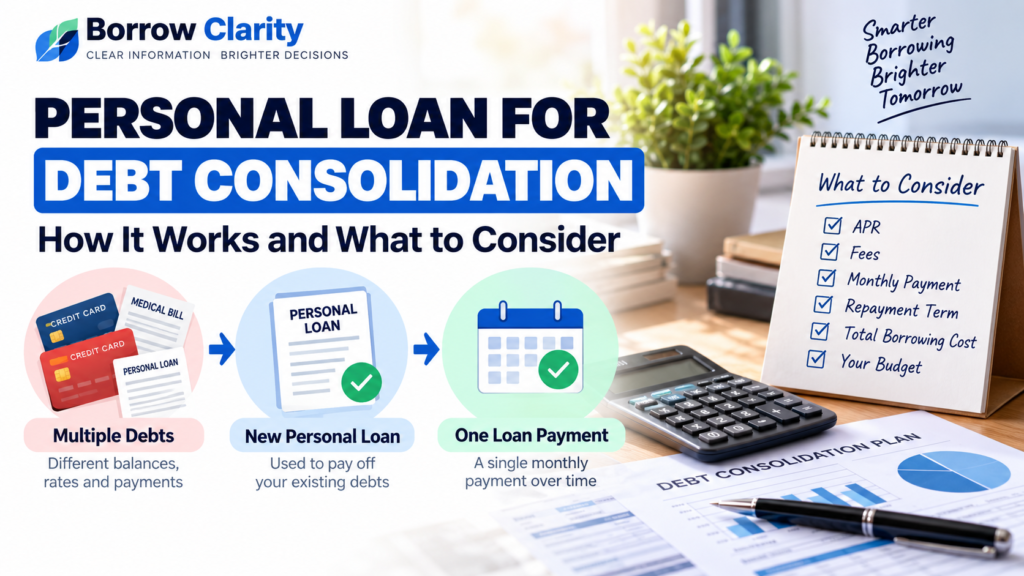
Using a personal loan for debt consolidation can combine multiple debts into one new loan with one monthly payment. This may make repayment easier to manage and, in some situations, could reduce borrowing costs.
But consolidation does not automatically make debt cheaper or easier to repay. The new loan may include fees, a different interest rate, and a longer repayment period. Before consolidating debt, compare what you owe today with the full cost and terms of the new loan.
Quick Answer: A debt consolidation personal loan is a new loan used to pay off multiple existing debts. Instead of making several payments, you repay the new loan over time. Whether consolidation makes financial sense depends on factors such as the APR, fees, repayment term, monthly payment, total borrowing cost, and your ability to avoid accumulating additional debt.
What Is a Personal Loan for Debt Consolidation?
A personal installment loan generally provides a lump sum that is repaid through scheduled installments over a specified period.
When a personal loan is used for debt consolidation, the borrowed money is used to pay off some or all of your existing debts. You then repay the new personal loan according to its terms.
You may have several separate balances and monthly payments.
A new loan may be used to pay the debts being consolidated.
You repay the new loan according to its repayment schedule.
The Consumer Financial Protection Bureau explains that debt consolidation loans may be offered by banks, credit unions, and installment loan lenders. Combining debts can simplify the number of payments you need to manage, but the cost of the new loan still needs to be evaluated carefully.
How Does Debt Consolidation With a Personal Loan Work?
The exact process varies by lender and borrower, but it can generally involve the following steps.
Record balances, interest rates, minimum payments, and other important terms for the debts you are considering consolidating.
Estimate how much would be required to pay off the debts included in your consolidation plan.
Review potential APRs, fees, monthly payments, repayment terms, and overall borrowing costs.
If you decide to proceed, complete the lender’s application and provide the requested information.
Depending on the lender and loan process, loan proceeds may be used to pay the applicable existing debts.
You make payments according to the new personal loan agreement.
Example of How Debt Consolidation Can Simplify Payments
Consider a simplified example in which someone has three separate debts:
| Before Consolidation | Balance | Monthly Payment |
|---|---|---|
| Debt A | $3,000 | $120 |
| Debt B | $4,000 | $160 |
| Debt C | $3,000 | $120 |
| Total | $10,000 | $400 |
If those eligible debts were paid with one $10,000 personal loan, the borrower would generally make payments on the new loan instead of managing the three separate payments.
Important: This example only illustrates how multiple payments can become one payment. It does not demonstrate savings. Whether consolidation saves money depends on the actual APR, fees, repayment period, and other terms of the new loan compared with the debts being replaced.
Potential Benefits of Debt Consolidation
Depending on the new loan and your existing debts, consolidation may have potential advantages.
Combining several debts can reduce the number of separate monthly payments you need to track.
A new loan may have a different interest rate from the debts being consolidated.
A personal installment loan generally has a repayment schedule over a specified period.
One scheduled loan payment may be easier to incorporate into a monthly budget than several separate payments.
Debt Consolidation Does Not Automatically Save Money
One of the most important points to understand is that a lower monthly payment does not necessarily mean a lower total cost.
According to the CFPB, a debt consolidation loan may produce a lower monthly payment because the debt is being repaid over a longer period. When the longer repayment period and loan costs are considered, you could potentially pay more overall.
Don’t Compare Monthly Payments Alone: Compare the APR, fees, repayment term, amount financed, and overall cost of the new loan with the debts you are considering replacing.
Compare the APR
When evaluating a personal loan for debt consolidation, APR is an important number to review.
Do not simply compare the advertised interest rate with your existing debts. Review the lender’s actual disclosures and understand what costs are included.
For a deeper explanation, read Personal Loan APR Explained .
Check the Fees
Personal installment loans can include fees that increase the overall cost of borrowing.
CFPB guidance lists examples such as origination fees, documentation fees, certain insurance charges, and late fees. The fees applicable to any particular loan depend on the lender and loan.
If an origination fee or another charge applies, determine how it affects both the amount you receive and the overall cost of consolidation.
Learn more in Personal Loan Fees Explained .
Pay Attention to the Repayment Term
A longer repayment term may reduce the required monthly payment, but it also means making payments for a longer period.
When comparing consolidation options, consider both:
- Whether the monthly payment fits your budget
- How the repayment period affects your overall borrowing cost
Continue with Personal Loan Repayment Terms Explained .
What Should You Compare Before Consolidating Debt?
| Factor | Existing Debts | New Consolidation Loan |
|---|---|---|
| Balances | How much you currently owe | How much you would borrow |
| Interest / APR | Rates on existing debts | APR offered on the new loan |
| Fees | Existing applicable charges | Origination or other applicable loan fees |
| Monthly Payments | Total of current required payments | Required payment on the new loan |
| Repayment Time | Remaining repayment periods | Term of the new loan |
| Overall Cost | Estimated cost if you continue current repayment | Estimated cost of repaying the new loan |
Our How to Compare Personal Loan Offers guide explains the comparison process in more detail.
Consider Why the Debt Accumulated
Consolidating existing balances changes how those debts are financed, but it does not by itself address the reason the balances accumulated.
CFPB guidance recommends understanding why you are in debt and reviewing your budget before moving forward with consolidation. If expenses consistently exceed income, replacing old debt with a new loan may not solve the underlying problem.
Think Beyond the Loan: A consolidation strategy may be more effective when it is paired with a realistic budget and a plan to avoid adding new balances that cannot be repaid.
Be Careful About Running Up New Balances
Paying off credit card balances with a personal loan can free up available credit on those cards.
If the cards are then used to accumulate new balances while the consolidation loan is still outstanding, you could end up managing both the new loan and new credit card debt.
Consider how you will manage future spending before using new debt to pay off existing balances.
Debt Consolidation vs. Debt Settlement
These terms can sound similar, but they describe different approaches.
| Debt Consolidation Loan | Debt Settlement |
|---|---|
| A new loan may be used to repay existing debts. | A company may attempt to negotiate with creditors to accept less than the amount owed. |
| You repay the new loan. | The process may involve accumulating money for potential settlements. |
| Does not inherently require stopping payments to creditors. | Some debt settlement companies may encourage consumers to stop making payments while negotiations are attempted. |
The CFPB warns that debt settlement can involve significant risks. Stopping payments may lead to additional interest and fees, damage to credit, collection activity, and potentially lawsuits.
Watch for Debt Relief and Consolidation Scams
Be cautious when advertisements promise to eliminate debt quickly, guarantee large reductions, or pressure you to provide personal or financial information.
The FTC warns consumers about debt relief companies that demand money upfront before providing promised results or guarantee that they can settle all debts.
Warning Signs: Be especially cautious of unexpected calls or messages promising fast debt forgiveness, guaranteed results, or demanding upfront payment before debts are settled.
Alternatives to a Personal Loan for Debt Consolidation
A personal loan is not the only possible approach to managing debt. Depending on your circumstances, alternatives may include:
Review whether budgeting changes could allow you to repay existing debts without taking out a new loan.
Some creditors may be willing to discuss payment arrangements, payment dates, or other options.
Credit counselors may help with budgeting and evaluating debt management options.
Some credit cards offer promotional balance transfers, but fees, promotional periods, and post-promotional rates should be reviewed.
The appropriate approach depends on your debts, budget, credit profile, available terms, and other circumstances.
When Should You Be Especially Careful?
A consolidation loan deserves additional scrutiny when:
Debt Consolidation Checklist
How to Evaluate a Personal Loan Before Consolidating
If you decide that a personal loan is worth considering, do not evaluate only one lender or one number.
Depending on availability, you may be able to check potential options before completing a full application. Remember that prequalification does not guarantee final approval and lender credit inquiry practices vary.
Read: Personal Loan Prequalification Explained .
When you are ready to understand the application process, continue with: How to Apply for a Personal Loan .
Before consolidating: Compare the new loan’s APR, fees, repayment term, monthly payment, and total borrowing cost with your existing debts. Use our Personal Loan Offers Comparison Guide to review the key factors before deciding whether an offer fits your situation.
Frequently Asked Questions
Can you use a personal loan to consolidate debt?
Personal installment loans may be used for consolidating existing debt. Whether a particular loan can be used for your intended purpose depends on the lender’s terms and your circumstances.
Does debt consolidation reduce your debt?
A consolidation loan generally restructures eligible existing debt into a new loan. It does not automatically reduce the principal amount you owe, and the new loan can include interest and fees.
Does debt consolidation always lower your monthly payment?
No. The payment depends on the amount borrowed, interest or APR, applicable fees, repayment term, and other loan terms.
Is a lower monthly payment always better?
Not necessarily. A lower payment may result from a longer repayment period, which can increase the amount paid over time. Compare the overall cost as well as the monthly payment.
Is debt consolidation the same as debt settlement?
No. Debt consolidation generally involves combining debts, often through a new loan. Debt settlement generally involves attempting to negotiate repayment of less than the amount owed and can involve different risks.
Should I use a personal loan to consolidate credit card debt?
That depends on the terms available and your financial circumstances. Compare the APR, fees, repayment period, monthly payment, and overall cost of the proposed loan with your existing credit card debts before deciding.
Bottom Line
A personal loan for debt consolidation can simplify several debts into one loan payment, but convenience alone does not determine whether consolidation makes financial sense.
Compare the APR, fees, repayment period, monthly payment, and overall borrowing cost with your existing debts. Also consider why the debt accumulated and whether the new repayment plan fits realistically within your budget.
Debt consolidation is different from debt settlement, and consumers should be cautious of companies promising guaranteed savings, rapid debt forgiveness, or other results that sound too good to be true.
Continue Learning About Personal Loans
Visit our Personal Loans Guide .
Before looking at potential options, understand Personal Loan Requirements .
Learn about Personal Loan Prequalification and How to Apply for a Personal Loan .
When evaluating potential borrowing options, read How to Compare Personal Loan Offers .
Sources
- Consumer Financial Protection Bureau (CFPB) — What do I need to know about consolidating my credit card debt?
- Consumer Financial Protection Bureau (CFPB) — Credit counseling, debt settlement, debt consolidation, and credit repair
- Consumer Financial Protection Bureau (CFPB) — Do personal installment loans have fees?
- Federal Trade Commission (FTC) — How To Get Out of Debt
Disclaimer: This article is for educational and informational purposes only and should not be considered financial, legal, tax, credit, or lending advice. Borrow Clarity is not a lender, debt settlement company, or credit counseling organization and does not make credit decisions. Loan availability, eligibility requirements, APRs, interest rates, fees, loan amounts, repayment terms, and approval decisions vary by lender and borrower. Debt consolidation may not reduce your borrowing costs and may not be appropriate for every situation. Review lender disclosures and consider your individual financial circumstances before borrowing.