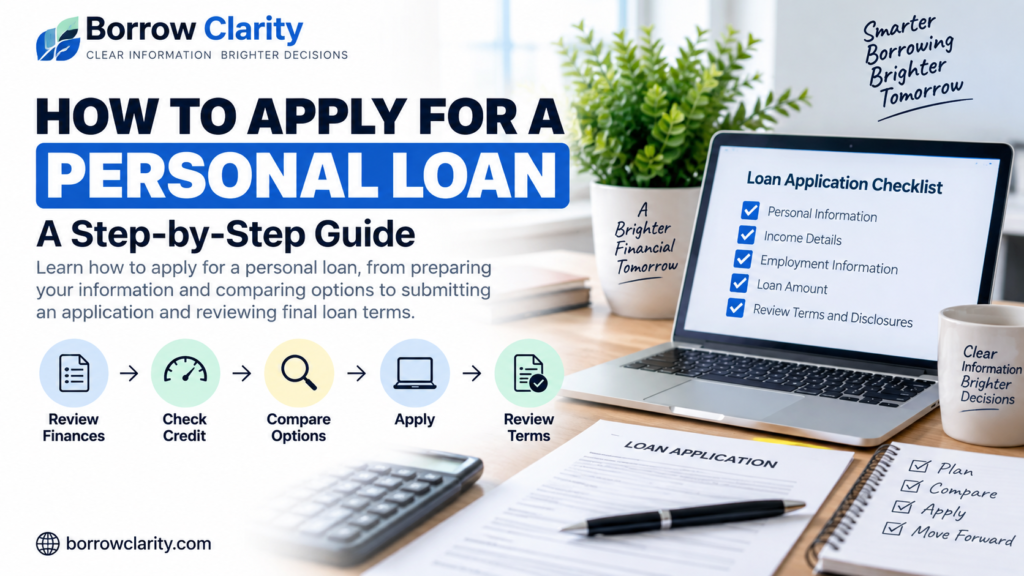
Learning how to apply for a personal loan before you start can help you prepare your information, compare borrowing options, and understand the costs involved before accepting a loan.
The exact application process varies by lender, but it commonly involves reviewing your finances, researching lenders, checking potential options, submitting an application, providing requested information, and carefully reviewing the final loan terms.
Quick Answer: Before applying for a personal loan, decide how much you need, review your budget and credit, compare potential lenders and loan terms, gather the requested information, complete the application accurately, and review the APR, fees, monthly payment, repayment term, and loan agreement before accepting an offer.
How to Apply for a Personal Loan in 7 Steps
Determine how much you need and what payment may fit your budget.
Check your credit information and look for possible errors.
Compare legitimate lenders and understand their requirements.
Explore potential options when available and check the credit inquiry type.
Compare APRs, fees, payments, terms, and overall borrowing costs.
Prepare the information and documentation the lender requests.
Apply accurately, then review final terms before accepting any offer.
Step 1: Decide How Much You Need to Borrow
Before looking at lenders, start with the reason you are considering a personal loan and determine how much money you actually need.
Borrowing more than necessary can increase the amount you must repay and may increase your total borrowing cost. At the same time, the monthly payment needs to fit realistically within your budget.
Review your regular income, essential expenses, existing debt payments, and other financial obligations before deciding on a loan amount.
Before Borrowing: Being eligible for a particular loan amount does not necessarily mean that borrowing the maximum available amount is appropriate for your financial situation.
Step 2: Review Your Credit Before Applying
Your credit history can play an important role in a lender’s evaluation of a personal loan application.
The Consumer Financial Protection Bureau notes that lenders may consider factors including credit scores and credit reports, income, debts, the amount borrowed, and the length of the loan when determining personal installment loan terms.
Reviewing your credit information before applying can help you understand what lenders may see and give you an opportunity to identify information that may be inaccurate.
For more information about what lenders may consider, read Personal Loan Requirements: What You May Need to Qualify .
Step 3: Research Potential Lenders
Personal loans may be available from banks, credit unions, online lenders, and other financial institutions.
Do not evaluate a lender based only on an advertisement or a promised monthly payment. Research the company, review its terms and disclosures, and make sure you understand who is actually providing the loan.
The Federal Trade Commission recommends shopping around because different lenders may offer different rates and terms.
Watch for Loan Scams Before You Apply
Be cautious of anyone who promises or guarantees that you will receive a loan regardless of your credit history and then demands money before providing the promised credit.
The Federal Trade Commission warns that advance-fee loan scammers may describe an upfront payment as a processing fee, insurance fee, application fee, or another charge.
Scam Warning: A legitimate lender may have legitimate fees associated with a loan or application, but paying a fee should never be presented as a guarantee that you will receive a loan.
Step 4: Check Prequalification Options When Available
Some lenders may offer a preliminary screening or prequalification process before a full application.
This may allow you to see potential borrowing options, but prequalification does not guarantee final approval and potential terms may change after verification and underwriting.
Before using a prequalification process, determine whether the lender will use a soft or hard credit inquiry.
Read our complete guide: Personal Loan Prequalification Explained .
Step 5: Compare Personal Loan Offers Carefully
If you have potential loan options, compare more than the advertised interest rate or monthly payment.
Important factors can include:
A standardized measure that can help you evaluate borrowing costs.
Review origination and other charges associated with the loan.
Determine whether the required payment fits your budget.
Understand how long you will be making payments.
Confirm the amount offered matches what you actually need.
Consider what the loan may cost over the full repayment period.
CFPB guidance notes that fees and charges can contribute to the total cost of a personal installment loan, so borrowers should review lender disclosures and loan documents before agreeing to the loan.
Continue with How to Compare Personal Loan Offers .
APR vs. Interest Rate
Do not automatically assume the interest rate and APR are the same.
APR can incorporate the interest rate plus certain additional charges associated with the loan, making it an important figure to review when comparing borrowing costs.
Learn more in Personal Loan APR Explained .
Step 6: Gather the Information the Lender Requests
Once you decide to submit an application, the lender may request information needed to identify you and evaluate the application.
Requirements vary by lender, but you may be asked for information or documentation related to areas such as:
Information used to identify and verify the applicant.
Information or documentation related to income.
Current residence information when requested.
Information about employment or other sources of income.
Information about current financial obligations.
The amount and purpose or other details requested by the lender.
These are general examples rather than a universal document checklist. Follow the specific lender’s instructions.
Step 7: Submit the Personal Loan Application
Complete the application accurately and review the information before submitting it.
A lender may review your credit and other financial information as part of its underwriting process. Additional verification may also be required before a final credit decision is made.
Do not assume that submitting an application guarantees approval or that previously displayed potential terms will necessarily become the final loan terms.
What Happens After You Apply?
What happens next depends on the lender and the application.
The lender evaluates the information provided.
Additional information or documentation may be requested.
The lender may approve or decline the application.
If approved, review the actual terms offered before accepting.
If you accept and complete the process, funding timing varies by lender.
How Long Does Funding Take After You Apply?
A credit decision and the arrival of funds are separate stages. Approval does not necessarily mean the money is available immediately. The time you wait can depend on any remaining verification, when you accept the agreement, the lender’s transfer process, and your bank’s processing schedule. Ask the lender when funds are expected to be available before relying on them for a payment deadline.
For a closer look at the stages and possible delays, read How Long Does It Take to Get a Personal Loan? .
Review the Loan Agreement Before Accepting
Approval is not the end of the decision-making process.
Before accepting a personal loan, carefully review the lender’s disclosures and loan agreement.
For more detail about possible charges, see Personal Loan Fees Explained .
Do Not Focus Only on the Monthly Payment
A lower monthly payment can look attractive, but it may result from a longer repayment period.
Extending the repayment period can change the overall amount you pay. Review both affordability today and the cost of the loan over time.
Read Personal Loan Repayment Terms Explained to understand how the repayment period affects a loan.
Common Mistakes When Applying for a Personal Loan
Applying without reviewing your budget.
A loan payment needs to fit alongside your existing expenses and debts.
Looking only at the interest rate.
APR, fees, repayment term, and overall borrowing cost also matter.
Borrowing more than you need.
A larger loan can increase the amount that must be repaid.
Accepting the first option without comparing.
Different lenders may provide different terms.
Assuming prequalification guarantees approval.
Final underwriting can produce a different decision or different terms.
Ignoring fees.
Fees can add to the overall cost of borrowing.
Responding to guaranteed-loan claims.
Be especially cautious when someone demands payment for a promise of
guaranteed credit.
Personal Loan Application Checklist
Frequently Asked Questions
What do I need to apply for a personal loan?
Requirements vary by lender. You may be asked for personal identifying information and information related to income, address, employment or income sources, existing debts, and the requested loan.
Should I check my credit before applying?
Reviewing your credit information before applying can help you understand your credit profile and identify potential inaccuracies before a lender evaluates your application.
Should I prequalify before applying?
When available, prequalification may help you understand potential options before a full application. However, lender processes differ, prequalification does not guarantee approval, and you should check what type of credit inquiry may occur.
How should I compare personal loan options?
Consider the APR, fees, interest rate, monthly payment, repayment term, loan amount, lender terms, and overall borrowing cost rather than comparing only one number.
Does applying guarantee I will receive the loan?
No. A lender must evaluate the application using its underwriting criteria. Approval, loan amount, APR, fees, and other terms can vary by lender and borrower.
How quickly will I receive the money?
Funding times vary by lender and circumstances. Avoid assuming that an advertised funding time will apply to every application. Review the lender’s actual terms and process.
Bottom Line
Understanding how to apply for a personal loan can help you approach the process in a more organized way.
Start by determining how much you need and reviewing your budget and credit. Research lenders, consider prequalification when appropriate, compare potential offers, and prepare the information required for a full application.
Most importantly, approval alone should not determine whether you accept a loan. Review the APR, fees, monthly payment, repayment period, and overall borrowing cost before agreeing to the final terms.
Continue Learning About Personal Loans
Start with the Personal Loans Guide .
Learn what lenders may review in Personal Loan Requirements .
Understand the step before applying in Personal Loan Prequalification Explained .
Then learn how to evaluate potential options with How to Compare Personal Loan Offers .
Sources
- Consumer Financial Protection Bureau (CFPB) — What is a personal installment loan?
- Consumer Financial Protection Bureau (CFPB) — Do personal installment loans have fees?
- Consumer Financial Protection Bureau (CFPB) — What is the difference between a loan interest rate and the APR?
- Federal Trade Commission (FTC) — What to Know About Advance-Fee Loans
Disclaimer: This article is for educational and informational purposes only and should not be considered financial, legal, tax, or lending advice. Borrow Clarity is not a lender and does not make credit decisions. Application requirements, eligibility standards, credit inquiry practices, approval decisions, APRs, fees, loan amounts, repayment terms, and funding times vary by lender and borrower. Applying for or prequalifying for a loan does not guarantee approval. Always review the lender’s disclosures and your individual financial situation before borrowing.