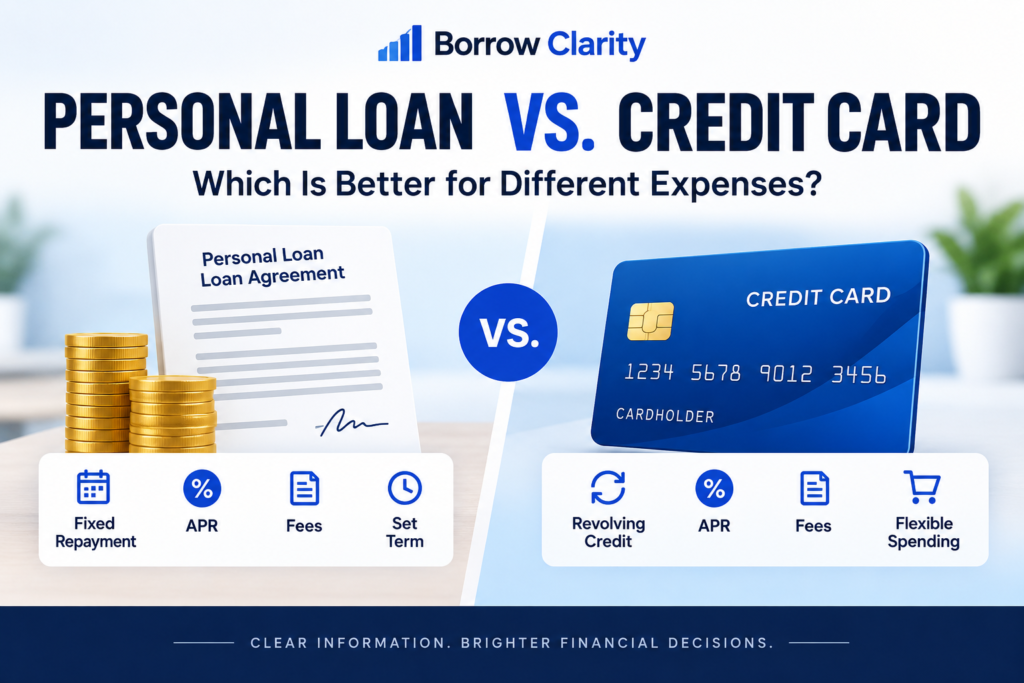
Personal loan vs credit card: both can provide access to borrowed money, but they work differently. A personal loan generally provides a lump sum that is repaid over a defined period, while a credit card provides a revolving line of credit that can be used repeatedly up to the available credit limit.
The right option for a particular expense depends on several factors, including how much you need to borrow, how quickly you expect to repay it, the APR and fees offered to you, and whether you need predictable payments or ongoing access to credit.
Quick Answer: A personal loan may be worth considering when you need a defined amount and prefer a structured repayment schedule. A credit card may provide more flexibility for purchases and short-term expenses, particularly when you can pay the purchase balance in full during an applicable grace period. Always compare the actual APR, fees, repayment terms, and total borrowing cost before deciding.
Personal Loan vs Credit Card: What’s the Difference?
The biggest difference is the structure of the credit.
A personal installment loan is generally a closed-end loan. You receive the borrowed amount upfront and repay it in scheduled installments over a specified period.
A credit card is revolving credit. You can make purchases up to your available credit limit, repay some or all of the balance, and generally continue using available credit while the account remains open and in good standing.
| Feature | Personal Loan | Credit Card |
|---|---|---|
| Credit Structure | Typically a lump-sum, closed-end installment loan | Revolving line of credit |
| Repayment | Generally scheduled installments over a defined term | Minimum payment required; balance can generally revolve |
| Access to Funds | Loan proceeds generally provided upfront | Available credit can generally be reused as balances are repaid |
| Interest | Depends on the loan’s rate and terms | Interest may apply when a balance is carried |
| Fees | May include origination or other loan fees | May include annual, late, balance-transfer, cash-advance, or other fees depending on the card |
| Payment Predictability | Payments are generally set according to the loan agreement | Required payment can change with the balance and account terms |
How a Personal Loan Works
According to the Consumer Financial Protection Bureau (CFPB), a personal installment loan provides a sum of money that is generally repaid in set or fixed amounts over a specific period of time.
Personal loans may be used for purposes such as large purchases, unexpected expenses, or consolidating existing debt.
The interest rate and terms available to a borrower can depend on factors such as credit history, income, existing debts, the amount borrowed, and the length of the loan.
Learn more about the repayment structure in our guide: Personal Loan Repayment Terms Explained .
How a Credit Card Works
A credit card provides revolving credit rather than a one-time installment loan. Purchases increase the card balance and payments reduce it, making credit available again subject to the account’s credit limit and terms.
Credit cards generally require at least a minimum payment when a balance is owed. If you carry a balance, interest may be charged according to the card agreement and applicable APR.
Many credit card issuers calculate interest daily based on the account balance. This makes it important to understand the card’s APR and how interest is calculated before carrying debt.
Visit our Credit Cards Guide for more educational resources about using and comparing credit cards.
Personal Loan vs Credit Card for Interest Costs
Do not assume that either type of credit will always have the lower borrowing cost.
The actual cost depends on the offer available to you, including the APR, fees, amount borrowed, repayment period, and how quickly you repay the balance.
For personal loans, review both the interest rate and APR. The APR can provide a broader view of borrowing cost because certain loan fees may be reflected in it.
For credit cards, the APR is also important, particularly if you expect to carry a balance from month to month.
Borrow Clarity Tip: Compare actual offers rather than assuming that all personal loans are cheaper than credit cards or that all credit cards are more flexible and less expensive.
When a Credit Card Grace Period Can Matter
One important difference involves credit card grace periods.
The CFPB explains that a grace period is the period between the end of a billing cycle and the payment due date. Credit card companies are not required to provide one, although many cards provide a grace period for purchases.
If your card provides an applicable grace period and you are eligible for it, paying the purchase balance in full by the due date can allow you to avoid interest on those purchases.
Grace-period rules vary, and they generally do not work the same way for transactions such as cash advances. Always review the cardholder agreement.
Personal Loan vs Credit Card for a Large Planned Expense
When you know approximately how much you need to borrow for a larger expense, a personal loan can provide a defined borrowing amount and a structured repayment schedule.
That structure can make it easier to see how long repayment is expected to take, assuming payments are made according to the loan agreement.
A credit card can also be used for purchases if the available credit limit is sufficient, but carrying a large balance can result in interest charges according to the card’s APR and terms.
Compare the complete cost of both options before making a decision.
Personal Loan vs Credit Card for Smaller or Short-Term Purchases
For smaller purchases, a credit card may offer convenient access to existing credit without applying for a separate installment loan each time.
If the card provides a grace period and the applicable purchase balance is paid in full by the due date, it may be possible to avoid interest on those purchases.
However, repeatedly carrying balances can turn short-term spending into longer-term debt. Consider whether you have a realistic repayment plan before charging an expense.
Personal Loan vs Credit Card for Debt Consolidation
Personal loans are sometimes used to consolidate multiple debts into one installment loan. This can simplify the number of payments a borrower must manage.
However, consolidation does not automatically reduce the cost of debt. A lower monthly payment may result from extending repayment over a longer period, which can increase the amount paid over time.
Credit card balance-transfer offers are another possible consolidation method. Some cards offer temporary low or promotional rates, but the promotional period may expire and balance-transfer fees may apply.
Important: Moving debt from one product to another does not eliminate the debt. Compare the APR, fees, promotional period, repayment timeline, and total expected cost before consolidating.
Which Option Offers More Predictable Payments?
A personal installment loan generally follows a defined repayment schedule. This can make the payment structure more predictable when the loan has fixed payments.
Credit card payments can vary as the balance changes. Paying only the required minimum can also extend the time it takes to repay a balance.
Borrowers who value a defined repayment schedule may find the structure of an installment loan easier to plan around, while borrowers who need revolving access to credit may value the flexibility of a credit card.
What Fees Should You Compare?
Fees can materially affect borrowing costs and should be reviewed before choosing either product.
Personal Loan Costs to Check
- Origination fees
- Documentation fees
- Late-payment fees
- Optional insurance-related costs
- Other charges disclosed by the lender
Credit Card Costs to Check
- Purchase APR
- Annual fee, if any
- Late-payment fees
- Balance-transfer fees, when applicable
- Cash-advance costs, when applicable
For a deeper look at personal loan costs, read: Personal Loan Fees Explained .
Considering a personal loan? If a personal loan appears to fit your needs, compare APRs, fees, repayment terms, monthly payments, and total borrowing costs before choosing an offer. See our Personal Loan Offers Comparison Guide.
Questions to Ask Before Choosing
Instead of starting with the question “Which product is better?”, start with the details of your borrowing situation.
- How much money do I actually need?
- Is this a one-time expense or recurring spending?
- How quickly can I realistically repay the debt?
- What APR am I being offered?
- What fees apply?
- Will the interest rate remain fixed or can it change?
- What will my required payments look like?
- How much could the borrowing cost overall?
- Can the payment comfortably fit within my budget?
Personal Loan vs Credit Card: A Simple Decision Framework
A Personal Loan May Be Worth Comparing When:
- You need a defined amount for a specific expense.
- You prefer a structured repayment schedule.
- You want to know the expected repayment period upfront.
- You are comparing options for consolidating existing debt.
A Credit Card May Be Worth Comparing When:
- You need revolving access to credit.
- The expense is relatively short term.
- You expect to repay purchases quickly.
- You understand the card’s APR, fees, and grace-period rules.
These examples are educational considerations, not recommendations. Individual offers, borrowing costs, and financial circumstances vary.
Frequently Asked Questions
Is a personal loan better than a credit card?
Neither is automatically better. Personal loans and credit cards have different structures, costs, and repayment features. Compare the actual APR, fees, repayment terms, and your ability to repay before deciding.
Is a personal loan cheaper than a credit card?
Not necessarily. The cost depends on the specific offers available to you, including APR, fees, repayment period, and how quickly the debt is repaid.
Can I avoid credit card interest?
Depending on the card and your account status, you may be able to avoid interest on purchases when an applicable grace period is available and you pay the purchase balance in full by the due date. Review your cardholder agreement for the specific rules.
Can a personal loan be used to pay off credit cards?
Personal loans may be used for debt consolidation. However, borrowers should compare the new loan’s APR, fees, repayment period, monthly payment, and total expected cost before refinancing existing debt.
Which option is better for a large purchase?
It depends on the offers available and how you plan to repay the debt. Compare the cost and repayment structure of both options rather than choosing based only on the type of credit.
Bottom Line
The personal loan vs credit card decision depends on the expense, the borrowing terms available to you, and your repayment plan.
Personal loans generally provide a defined amount with a structured repayment period. Credit cards provide revolving access to credit and may offer interest-free purchase periods when applicable grace-period conditions are met.
Before borrowing, compare the APR, fees, repayment structure, monthly payment, and expected total cost. Most importantly, consider whether the debt can be repaid comfortably within your budget.
Continue Learning
Start with our Personal Loans Guide for more borrowing resources.
Learn how to compare loan offers in How to Choose the Right Personal Loan .
Understand borrowing costs in Personal Loan APR Explained .
Or explore our Credit Cards Guide to learn more about credit cards.
Sources
- Consumer Financial Protection Bureau (CFPB) — What is a personal installment loan?
- Consumer Financial Protection Bureau (CFPB) — Credit cards key terms
- Consumer Financial Protection Bureau (CFPB) — What is a grace period for a credit card?
- Consumer Financial Protection Bureau (CFPB) — Do personal installment loans have fees?
- Consumer Financial Protection Bureau (CFPB) — What should I know about consolidating credit card debt?
Disclaimer: This article is for educational and informational purposes only and should not be considered financial, legal, tax, or lending advice. Borrow Clarity is not a lender and does not make credit decisions. Credit availability, APRs, fees, repayment terms, promotional offers, and other conditions vary by lender, card issuer, and borrower. Always review the applicable disclosures and consider your individual financial situation before borrowing.