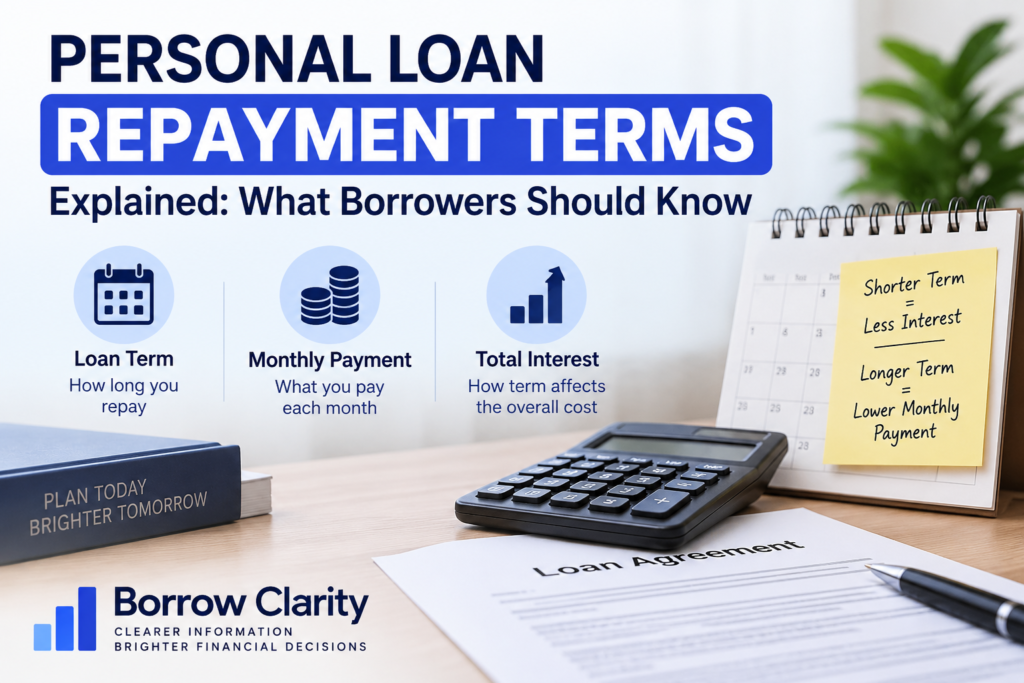
Personal loan repayment terms determine how long you have to repay a loan and can affect your monthly payment as well as the overall cost of borrowing. Understanding the repayment period before accepting a loan can help you compare offers more effectively and choose payments that better fit your budget.
A shorter repayment term generally means fewer payments and potentially less interest paid over time, but the monthly payment may be higher. A longer term can make monthly payments smaller, but borrowing for a longer period may increase the total amount of interest you pay.
Quick Answer: A personal loan repayment term is the period of time you have to repay the loan. When comparing loan offers, consider the repayment term together with the APR, monthly payment, fees, and total borrowing cost rather than focusing on the monthly payment alone.
Personal Loan Repayment Terms Explained
A personal installment loan generally provides money upfront that is then repaid in scheduled installments over a specified period.
According to the Consumer Financial Protection Bureau (CFPB), personal installment loans are generally repaid in set or fixed amounts over a specific period of time. Loan lengths can vary considerably depending on the lender, the amount borrowed, and other loan terms.
The repayment term is important because it influences how many payments you make and can affect both your monthly payment and overall borrowing costs.
How Does a Personal Loan Repayment Term Work?
Suppose a borrower receives a personal loan that must be repaid over a specified number of months. The lender establishes a payment schedule based on the loan agreement.
For many installment loans, payments are generally scheduled in regular amounts throughout the repayment period. Each payment helps repay the amount borrowed and applicable interest according to the loan terms.
The exact payment structure depends on the lender and loan agreement, so borrowers should review their loan documents carefully before accepting an offer.
Shorter vs. Longer Repayment Terms
One of the most important decisions when evaluating a loan is understanding the tradeoff between a shorter and longer repayment period.
| Factor | Shorter Term | Longer Term |
|---|---|---|
| Number of Payments | Fewer | More |
| Monthly Payment | Generally higher, all else equal | Generally lower, all else equal |
| Time in Debt | Shorter | Longer |
| Total Interest | Can be lower | Can be higher |
| Budget Impact | Higher required payment may put more pressure on the monthly budget | Lower required payment may be easier to fit into a monthly budget |
These are general comparisons rather than guarantees. Actual costs depend on the loan amount, APR, fees, interest structure, and specific terms offered by the lender.
How Loan Term Affects Your Monthly Payment
When other loan terms are similar, spreading repayment across more months generally reduces the amount that must be paid each month.
This can make a longer-term loan appear more affordable when looking only at the monthly payment. However, the monthly payment does not tell the entire story.
Borrow Clarity Tip: Do not compare personal loans using monthly payments alone. Compare the APR, fees, repayment term, monthly payment, and overall borrowing cost together.
How Loan Term Can Affect Total Interest
Extending repayment over a longer period can mean paying interest for more time. As a result, a loan with a smaller monthly payment is not necessarily the less expensive option overall.
CFPB consumer guidance on comparing loans emphasizes that a longer loan term can reduce monthly payments while increasing the interest paid over the life of a loan.
This is why both affordability today and total borrowing cost over time should be considered when reviewing loan offers.
A Simple Repayment-Term Example
Consider two hypothetical personal loan offers for the same amount. The examples below are designed only to illustrate the tradeoff between repayment periods.
Loan A: Shorter Term
Loan amount: Same in both examples
Repayment period: Shorter
Monthly payment: Generally higher
Time paying interest: Shorter
Loan B: Longer Term
Loan amount: Same in both examples
Repayment period: Longer
Monthly payment: Generally lower
Time paying interest: Longer
The lower monthly payment in the longer-term example should not automatically be interpreted as the better deal. The actual comparison requires reviewing the APR, fees, payment schedule, and total cost of each offer.
This hypothetical example is for educational purposes only and does not represent a particular lender, loan product, or offer.
What Determines Your Personal Loan Terms?
Lenders may consider a variety of factors when determining the interest rate and terms available to a borrower.
According to the CFPB, these can include factors such as:
- Credit score and credit reports
- Income
- Existing debts
- The amount of the loan
- The length of the loan
- Interest rates permitted by applicable state law
- Other information considered by the lender
Loan terms therefore can vary from one borrower or lender to another.
What Should You Compare Besides the Repayment Term?
Repayment length is only one part of a personal loan offer. Consider the following factors together before making a borrowing decision.
1. APR
APR can provide a broader measure of borrowing cost than the interest rate alone because it can reflect the interest rate and certain additional charges.
Learn more in our guide: Personal Loan APR Explained: What Borrowers Should Know .
2. Fees
Personal installment loans may include charges such as origination fees, documentation fees, certain insurance-related costs, or late fees, depending on the loan.
See: Personal Loan Fees Explained: What Borrowers Should Know .
3. Monthly Payment
Determine whether the required payment is manageable alongside housing, food, transportation, existing debt payments, savings goals, and other financial obligations.
4. Total Borrowing Cost
A manageable monthly payment is important, but it should be considered alongside how much the loan may cost over the entire repayment period.
5. Loan Agreement
Review the lender’s disclosures and loan documents carefully. Make sure you understand the payment schedule, applicable fees, consequences of missed payments, and other important terms before accepting the loan.
Next step: Repayment term is only one part of evaluating a loan. Compare repayment terms alongside APRs, fees, monthly payments, and total borrowing costs in our Personal Loan Offers Comparison Guide.
How to Choose a Repayment Term
There is no single repayment period that is appropriate for every borrower. A useful approach is to compare multiple scenarios rather than automatically selecting the option with the smallest monthly payment.
- Start with your budget. Determine how much room you realistically have for another required monthly payment.
- Compare several repayment periods. Look at how different terms change the required payment and overall cost.
- Compare APR and fees. A different term may also come with different pricing or costs.
- Consider your financial flexibility. A payment that leaves no room for unexpected expenses may create financial pressure.
- Review the complete loan offer. Read the disclosures and understand the terms before agreeing to borrow.
What Happens If You Miss a Personal Loan Payment?
Missing a required payment can have consequences beyond a possible late fee.
The CFPB notes that lenders may use debt collectors to collect unpaid amounts and may report payment information to credit reporting companies. Late or missed payments can therefore affect a borrower’s credit history.
If you believe you will be unable to make a payment, the CFPB recommends contacting the lender as soon as possible to understand what options may be available.
Important: Do not choose a repayment term based only on whether you can make the first few payments. Consider whether the payment appears sustainable throughout the full repayment period.
Questions to Ask Before Accepting a Repayment Term
- How long will I be making payments?
- How many payments will I make?
- What is the required monthly payment?
- Is the interest rate fixed or adjustable?
- What is the APR?
- What fees apply?
- How much will the loan cost if I make all payments as scheduled?
- What happens if a payment is late?
- Does the agreement contain any terms related to paying the loan off early?
- Does the payment fit comfortably within my budget?
Frequently Asked Questions About Personal Loan Repayment Terms
What is a personal loan repayment term?
It is the period over which a borrower is scheduled to repay a personal loan according to the loan agreement.
Is a longer personal loan term better?
Not necessarily. A longer term may reduce the required monthly payment, but it can also mean paying interest for a longer period. Compare both affordability and total borrowing cost.
Is a shorter personal loan term always better?
Not for every borrower. A shorter term can reduce the amount of time you are paying interest, but it generally requires higher monthly payments when other factors are similar. The payment still needs to fit your budget.
Can two loans for the same amount have different monthly payments?
Yes. Differences in repayment term, interest rate, APR, fees, and other loan terms can result in different payment amounts and borrowing costs.
Should I choose the loan with the lowest monthly payment?
Not automatically. A lower monthly payment can result from a longer repayment period. Compare the APR, fees, loan term, monthly payment, and total cost together.
What should I do if I cannot make a payment?
Contact your lender as soon as possible to discuss your situation and understand whether any options may be available under your loan agreement or the lender’s policies.
Bottom Line
Personal loan repayment terms affect more than the number of months you remain in debt. They can influence your required monthly payment and the amount of interest you may pay over time.
A shorter term may reduce the time spent paying interest but require a larger monthly payment. A longer term may make the monthly payment smaller but can increase borrowing costs over time.
Before accepting a loan, compare the repayment term together with the APR, fees, monthly payment, and overall borrowing cost. The goal is to understand the complete loan offer rather than choosing based on one number alone.
Continue Learning About Personal Loans
Start with our Personal Loans Guide for more educational resources.
Learn how to compare borrowing costs in Personal Loan APR Explained .
Review common borrowing charges in Personal Loan Fees Explained .
Or see our complete comparison checklist: How to Choose the Right Personal Loan: 7 Smart Tips .
Sources
- Consumer Financial Protection Bureau (CFPB) — What is a personal installment loan?
- Consumer Financial Protection Bureau (CFPB) — Do personal installment loans have fees?
- Consumer Financial Protection Bureau (CFPB) — How do I compare auto loan offers?
Disclaimer: This article is for educational and informational purposes only and should not be considered financial, legal, tax, or lending advice. Borrow Clarity is not a lender and does not make credit decisions. Loan availability, rates, fees, repayment terms, and other conditions vary by lender and borrower. Always review the lender’s disclosures and consider your individual financial situation before borrowing.